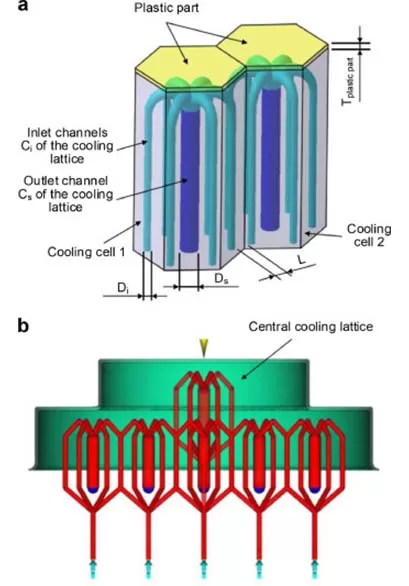
The mold cooling water system is an internal pipeline system within the mold that circulates cooling water or other cooling media to control the mold temperature and improve production efficiency and product quality during the injection molding process.
Traditional Water Channel Design
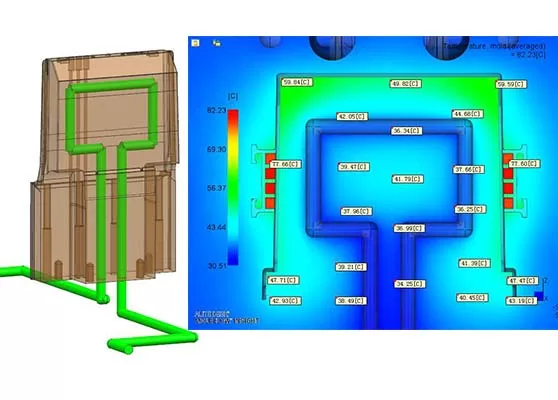
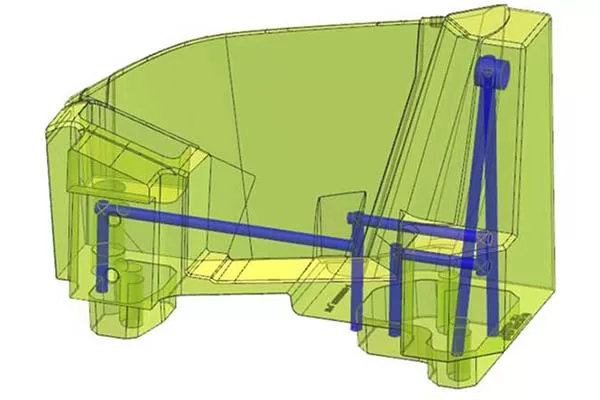
• Straight-line cooling channels that are positioned far or further away from the mold cavity. • Requires additional fittings for water channel assembly. • Contains more dead zones with poor cooling/heating efficiency. • Requires cutting and assembling multiple pieces, leading to cumulative errors and shorter mold lifespan.
Conformal Water Channel Design
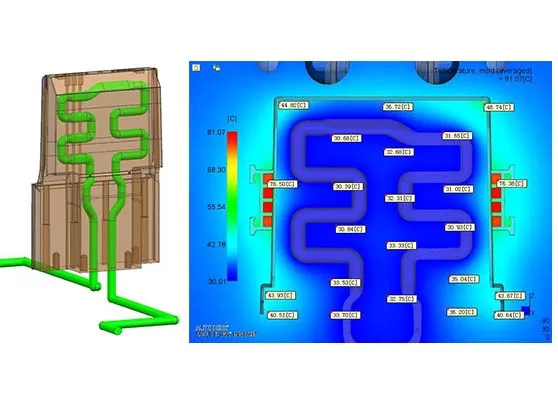
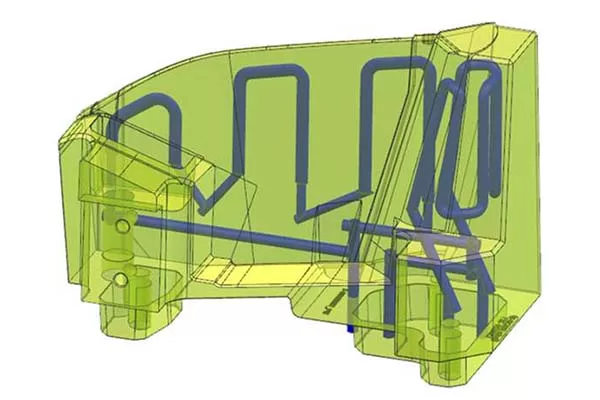
• Water channels designed to conform to the mold cavity surface, ensuring uniform proximity. • Avoids right angles for smooth flow and improved efficiency. • Allows for varying cross-sectional shapes of the water channels as needed. • Enables the design of multiple cooling circuits to enhance heat dissipation uniformity.
Venting Structure
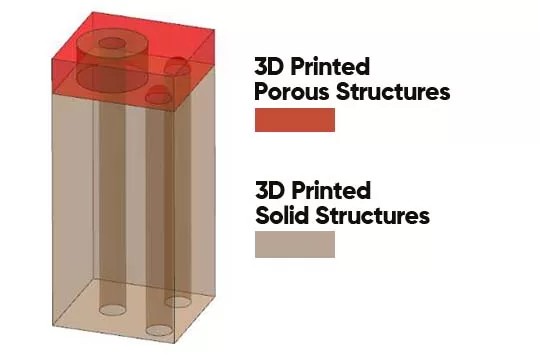
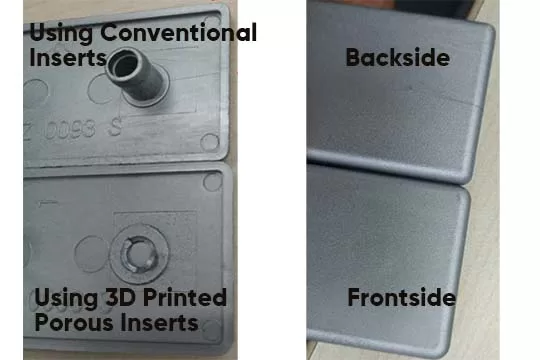
Venting structures are incorporated into molds to facilitate the escape of air or gases during the injection molding process. They help prevent air traps, ensuring complete filling of the mold cavity and reducing defects in the final product.
Resolves issues such as inadequate product filling, burning, and surface welding caused by the accumulation of gases inside the mold cavity.
Allows for free design of shapes and structures based on product requirements.
Low risk of blockage during precision machining.
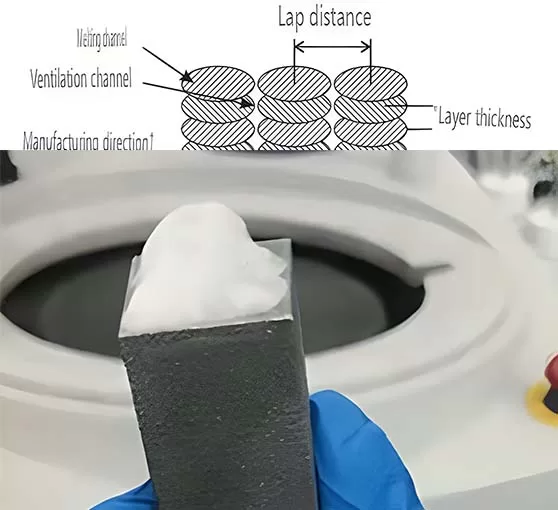
Porosity can be adjusted in the printing process based on the injection molding material.
Printing Technology
Rotational Overlap Printing Technology
Each layer is rotated in the existing printing process to eliminate anisotropy, ensuring uniform fusion between layers. This guarantees a continuous and clear venting channel on a microscopic scale, while maintaining good material permeability on a macroscopic level.
Hybrid Additive Manufacturing
Hybrid Additive Manufacturing combines traditional machining with 3D printing. It starts with a machined steel workpiece and uses 3D printing to add more metal layers, creating a complete part with complex shapes and customizable features. This approach enhances design flexibility and overall performance.
Essential low-stress printing process that effectively reduces the risk of cracking.
High-Gloss Technology
UM300 (1.2709)
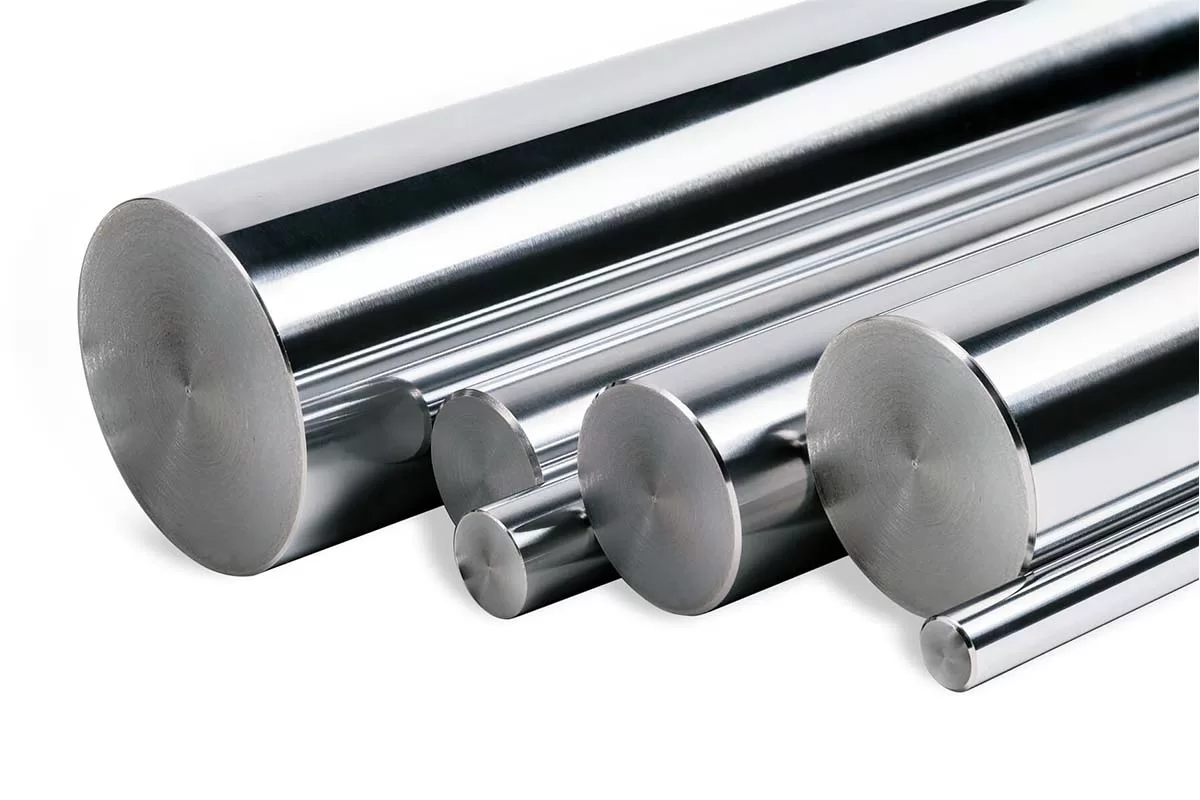
Standard general-purpose mold steel material
Extremely high strength and toughness
Hardness up to 52-54 HRC
Excellent polishing performance
Good welding capability
Good machinability
Simple heat treatment process
Not corrosion-resistant
Anco-X (Corrax)
Corrosion-resistant specialty material for molds with small-diameter water channels
High-performance martensitic stainless steel
Excellent corrosion resistance
Hardness up to 48-50 HRC
Excellent polishing performance
Good hybrid printing capability
UH100 (H13)
Suitable for die-casting molds and injection molds (high glass fiber content)
Extremely high resistance to thermal fatigue
Hardness up to 52-54 HRC
Excellent impact toughness and oxidation resistance
Good machinability
No need for heat treatment
Not corrosion-resistant
Suitable for both cold and hot molds
Classic Case Studies of 3D Printing in the Injection Mold Industry
These classic case studies highlight the significant impact of 3D printing in the injection mold industry, enabling faster production, improved design capabilities, and cost-effective customization.
cash one
Replacement of Traditional Mold Steel with 3D Printed Mold and Conformal Cooling Channels
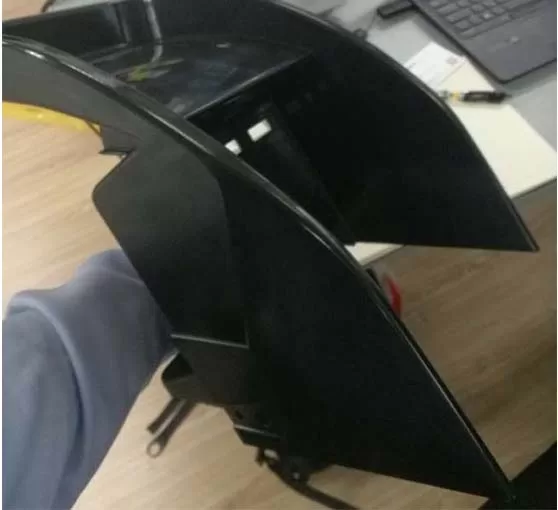
The product’s small dimensions in deep grooves make it challenging to incorporate traditional water channels, resulting in significant heat buildup.
Tooling cooling design
The product’s small dimensions in deep grooves make it challenging to incorporate traditional water channels, resulting in significant heat buildup.
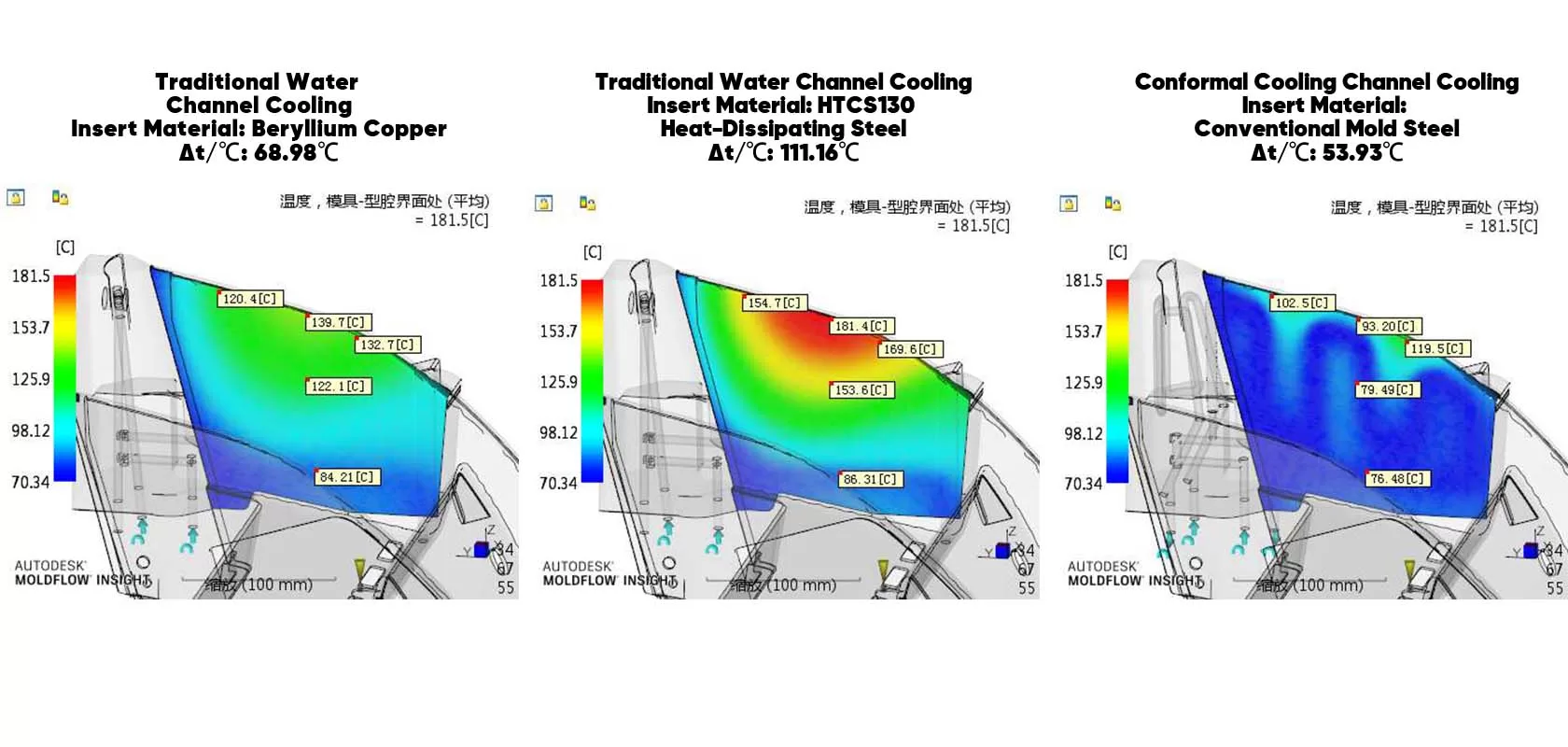
The original mold insert utilized beryllium copper with traditional water channels. However, the limited hardness and strength of beryllium copper led to issues like cracking and wear. Therefore, alternative solutions, such as heat-dissipating steel or conformal cooling channels, are being explored.
Traditional Water Channels
Conformal Cooling Channels
Mold flow analysis
Comparing three different forms of water channel cooling under the same mold temperature:
Traditional Water Channels, Beryllium Copper
Traditional Water Channels, HTCS130 Heat-Dissipating Steel
Conformal Cooling Channels, 1.2709 Mold Steel
Material Hardness (HRC)
HRC30-35
No data
HRC48-52
Mid Part Temperature (℃)
122.1
153.6
79.5
Hottest Point Temperature (℃)
139.7
181.4
119.5
Surface Temperature Difference (Δt/℃)
68.98
111.16
53.93
Get In Touch with Us
Fill in this form or click the service online, all questions will be answered.
Visit us
Floor 2, National mould Product Quality Supervision and Inspection Center,
No. 10 Lianhu Road,Chang'an town, Dongguan city, Guangdong province